The Shortcut That Sends Everyone the Long Way
A short route can feel long when turns, waits, and interruptions keep breaking the walk. Learn what to notice before calling a street a shortcut.
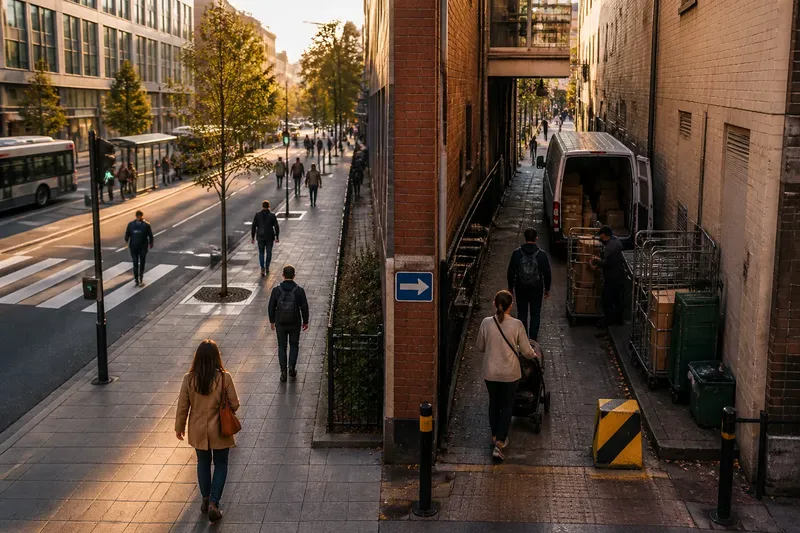
The most common shortcut mistake is choosing the line with the least map distance and assuming it will feel quickest. A short route across a city block can cost more patience than a longer, direct walk if it keeps making people stop, turn, and work out where to go next.
That difference matters in ordinary trips: walking to a bus stop, cutting through a shopping street, or crossing from one side of a large block to the other. A route is not just a line. It is a sequence of decisions and interruptions.
Why can a short route feel long?
Distance is easy to see on a map. Friction takes closer observation. A turn may hide the next stretch; a signal may hold someone at an empty-looking crossing; a delivery van may force a detour around the curb. Each interruption is small, but the walker experiences them in order, not as a tidy line.
Think of the route like a sentence with too many commas. The words may be few, but the pauses make it feel longer. For someone carrying groceries, pushing a stroller, or walking with a child, repeated pauses and direction changes can matter more than a modest difference in length.
What should you notice while walking a route?
Walk the route at the time people are likely to use it. A quiet midday passage may be crowded near school dismissal or a busy market hour. Watch for the moments when someone has to hesitate, yield, double back, or wait without knowing how long the delay will last.
- Turns: Note whether the next segment is visible before a turn. A sharp bend behind a building can make a route feel uncertain even when it is plainly marked.
- Crossings: Notice signal waits, turning traffic, and crossings that require a second pause on a narrow island.
- Interruptions: Look for loading activity, queues, outdoor seating, construction barriers, and other routine blockages.
- Wayfinding: Check whether street names, passage signs, and sightlines make the next move obvious to a visitor.
- Walking rhythm: Observe whether people can keep a steady pace or repeatedly bunch up and stop.
These notes are not a tally of who is walking “correctly.” They help identify where the street asks for extra attention or patience. A route that seems straightforward to a regular may be less legible to someone arriving for the first time.
When does a detour become the easier choice?
A longer route can feel easier if it offers a clear sightline, fewer decision points, and crossings that fit naturally into the walk. That does not mean every direct route should be abandoned. It means planners should compare the experience of moving through each route, not just their outlines.
Say a neighborhood map suggests cutting through a narrow passage between two busy streets. Imagine that the passage opens onto a loading area where carts often block the way, and its exit is hard to spot from inside. A slightly longer sidewalk route with a visible destination and a predictable crossing may feel simpler to a first-time visitor. The useful observation is not that one path is always best, but that the supposed shortcut has a pinch point worth addressing.
For a city team, a small change might be clearer signs at the passage entrance, a more visible opening, or a loading arrangement that leaves the walking line open. The right response depends on the place: some interruptions are temporary, while others come from how the block is used throughout the day.
How do turns, waits, and interruptions change route choice?
Do extra turns make a route feel longer?
They can, especially when each turn hides the destination or requires another wayfinding decision. A route with fewer, clearer changes of direction is often easier to follow than a shorter path that repeatedly asks, “Is this the right way?”
Why do signal waits matter so much?
A wait breaks walking rhythm and can make the trip feel unpredictable. A crossing that is easy to find and straightforward to use gives people a clearer sense of how the route continues.
Can a busy sidewalk turn a shortcut into a detour?
Yes. Queues, café furniture, deliveries, or clusters of people can narrow the usable path and make walkers slow down or step aside. The relevant question is whether these conditions recur at the times the route is most useful.
Should a route be judged differently at night?
It can be. Lighting, visible entrances, active frontages, and clear signs affect whether a path feels legible after dark. A route review should reflect the hours people actually need to use it, rather than relying on a single daytime visit.
How can a city make a shortcut easier to use?
Start by removing avoidable decisions and pauses. Make entrances easy to see from the approaching sidewalk, keep directional signs close to the point where someone must choose, and arrange recurring loading or seating so it does not repeatedly obstruct the walking line.
Then look at the sequence, not each feature in isolation. A visible entrance does little if the route ends at a confusing crossing; a clear crossing may still feel like a dead end if the next sidewalk is hidden behind parked vehicles. The handoff from one segment to another is where a clean map line often meets a messy street.
When comparing routes, describe both the distance and the experience: where people turn, where they wait, and what interrupts their progress. That makes “shortcut” a question people can answer with their feet, not just a label attached to a map. A useful shortcut is the one whose next move keeps making sense as you walk.