The Transfer Is Part of the Journey
A better transit transfer begins before you leave the first vehicle. Learn how to spot confusing handoffs and make arrival, orientation, and onward movement clearer.
The common mistake with a transit transfer is treating it as empty time between two rides. That makes a confusing platform, an unclear sign, or a slow crossing feel like a minor inconvenience—until it causes a missed connection, a rushed decision, or a detour through a station. A transfer is part of the journey, and its quality depends on how well arrival, orientation, and onward movement fit together.
When a connection goes wrong, the cause is often not the distance alone. Riders need to know where they are, where the next service leaves from, and how to reach it without losing track of time or direction. Treating those needs as one continuous sequence helps pinpoint the trouble and choose a useful fix.
Why does the transfer feel like a separate trip?
A transfer can feel detached when the first service ends at a door or platform with no clear visual or physical link to the next one. The passenger must stop, interpret a new environment, and work out which route applies. Even a short walk can become an uncertain gap if the next step is not apparent.
This is especially noticeable when modes meet in different spaces: a bus stop outside a rail station, a ferry terminal linked to a tram, or two train services using separate platforms. The operator’s route map may show a neat interchange symbol, but a person arriving there experiences pavement, entrances, fare barriers, stairs, corridors, and signs in sequence.
Think of a transfer like passing a note between two people. If the handoff is clear, the next person can continue without guessing; if it is muddled, the message stalls. For transport, the “note” is practical information: which way to go, whether to stay within a paid area, and what to look for when the next platform comes into view.
What to try: Describe the connection from the arrival point onward, not just as “the station.” Name the exact place a rider arrives, the decision they must make next, and the visible cue that should guide them. If that description depends on an unstated assumption, the transfer may be asking riders to supply the missing link themselves.
What if you arrive but cannot tell where to go?
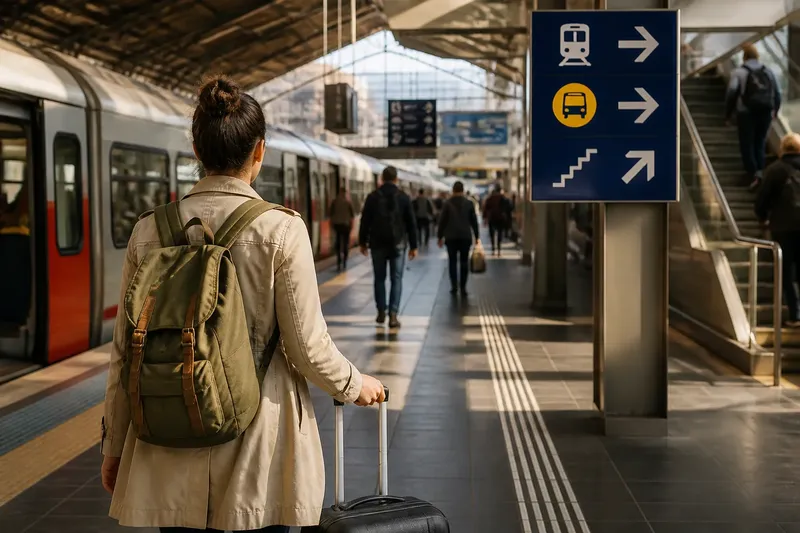
Orientation fails when signs appear too late, point in several directions without distinction, or use labels that do not match what passengers see on the ground. “Interchange” may identify the general area, but it does not necessarily tell someone whether to turn toward the concourse, descend to a lower platform, or leave the station for a bus stop.
Look for the decision points along the route. A rider may need one cue on the vehicle, another at the exit, and a further cue at a corridor junction. If the first useful direction appears only after the rider has passed the turn, even accurate information becomes frustrating.
What to try: Check whether the destination is named consistently across the map, station signs, and platform displays. Follow the route on foot and note where a first-time visitor could reasonably hesitate. A sign at the hesitation point is usually more useful than another general map at the entrance.
Do not solve every uncertainty by adding more text. Too many competing arrows can make the correct one harder to notice. Separate different decisions: indicate the mode or service first, then use a clear direction toward its platform or stop. Place information where people can read it without blocking the flow behind them.
Why do signs still fail when they are correct?
Accuracy is only one part of wayfinding. A sign can point in the right direction and still be hard to use if it is hidden behind a column, placed above a crowded sightline, or written in a vocabulary unfamiliar to occasional riders. It can also fail when it appears beside several other panels and offers no clear visual priority.
Check the sign from the position where a person must make a choice, not from the spot where it was installed. Is it visible as someone steps off the vehicle? Can a person using a wheelchair see it without searching above a crowd? Does the arrow indicate the actual route, including a turn or change of level, rather than merely the general direction?
What to try: Walk the connection at an ordinary pace and pause at each fork, exit, and change of level. Look for the next cue before you move. If you must backtrack to read a sign, or infer the route from a distant landmark, identify that exact point for improvement. Clear sightlines and repeated, consistent names can do more than a dense wall of instructions.
Information should also account for the way riders arrive. Someone stepping from a bus may face a different exit from a passenger arriving by train, even if both are headed toward the same service. A single sign may not serve both approaches. Trace each arrival path separately before deciding where a shared direction can work.
What if the connection is hard to move through?
A transfer can be easy to understand but difficult to travel. A narrow passage, a cluster of ticket machines, a heavy door, or a queue that spills across the route can interrupt onward movement. The result is not merely slower walking: people may be pushed into the wrong stream, miss a turn, or hesitate where others need to pass.
Observe how different movements overlap. People leaving a train may meet people approaching a bus stop, while those buying tickets pause beside the same doorway used by through-passengers. Notice where bags, strollers, mobility devices, and groups naturally need room. A route that works for a single quick walker may become awkward when people move at different speeds.
What to try: Keep the through-route legible and avoid placing optional tasks directly in its path. Where possible, position waiting, ticketing, and information points so that someone pausing does not block someone continuing. If a queue repeatedly occupies the connection, consider whether the queue can be guided or the service point relocated; the aim is to make onward movement obvious without asking riders to weave through a standing crowd.
Access also depends on continuity. A lift may be available but difficult to find from the arrival platform, or its route may send passengers through a separate entrance with little guidance. Evaluate the entire connection from start to finish, including changes in level and the point where an accessible route rejoins the main path. A route is only useful if riders can identify and follow it through the whole transfer.
How can you tell where a transfer sequence breaks?
Separate the connection into three questions: where do I arrive, how do I orient myself, and what carries me onward? This is not a demand for a complicated audit. It is a way to avoid fixing a visible symptom while leaving the real interruption in place.
- Arrival: Can a rider tell which platform, stop, exit, or side of the street they have reached?
- Orientation: Is the next service named and signposted before the rider must choose a direction?
- Movement: Is there a continuous, usable route to the next boarding point?
- Handoff: Does the next service’s location make sense from the route the rider has just followed?
- Recovery: If someone takes the wrong turn, can they recognize the mistake and find a clear way back?
Say you arrive by bus at a busy rail station and need a tram. The bus stop is clear, but the tram symbol appears only inside the station, after a fork between two entrances. Moving that sign—or adding a matching cue at the stop—could make the next decision visible before the rider chooses an entrance. The observable result to look for is straightforward: someone following the tram route can continue without stopping at the fork to guess.
For a real site, trace the route in both directions. A transfer that is easy from rail to bus may be confusing on the return because the bus stop is on the far side of the street or the station entrance is not visible. Also consider changes in service patterns: a temporary stop, closed corridor, or relocated boarding area can make familiar signs misleading. Keep directions aligned with the route people can actually use.
What should you check before changing the connection?
Start with the smallest clear break in the sequence. If riders cannot identify the correct exit, changing the platform layout may miss the problem. If the route is clear but blocked by queues, more signs will not create space. Match the response to the point where arrival, orientation, or movement stops working.
Useful options include repositioning a sign at a decision point, repeating a consistent destination name, clearing a sightline, relocating a waiting area, or making the continuous accessible route easier to recognize. Each change should support the next action without creating a new obstacle for people arriving from another direction.
Where the right answer depends on a transit operator’s instructions, station layout, or local accessibility and safety rules, check those requirements before changing signs, routes, or equipment. Changes involving station operations or public access should be coordinated with the responsible operator and qualified professionals where needed.
What do riders often ask about transfers?
How much time should I allow for a transfer?
There is no single time that suits every connection. The route may involve a long corridor, a level change, a ticket barrier, or a street crossing, so check the service information and allow for the actual path rather than assuming the two boarding points are adjacent.
Is a transfer the same as an interchange?
The terms are often used for a connection between services, but an interchange commonly refers to the place where those services meet. For a rider, the useful question is whether the route between them is clear and continuous, whatever the map calls it.
What makes a transfer accessible?
An accessible connection has a usable route through every part of the handoff, with clear directions to it and onward to the next service. A lift or ramp at one end does not resolve a gap elsewhere in the route.
What should I do if a transfer is disrupted?
Follow current operator directions and check for an alternate boarding point or route before leaving the station area. If signs conflict or the accessible route is unclear, ask staff for the current connection rather than relying on a familiar route that may have changed.
A well-designed transfer does not need to feel like a separate task. It lets riders recognize where they have arrived, understand the next choice, and keep moving toward the next service. When a connection feels confusing, look for the precise moment the sequence breaks; that is often where a modest, well-placed change can make the journey feel whole.